

The King, Parliament and the Bishops
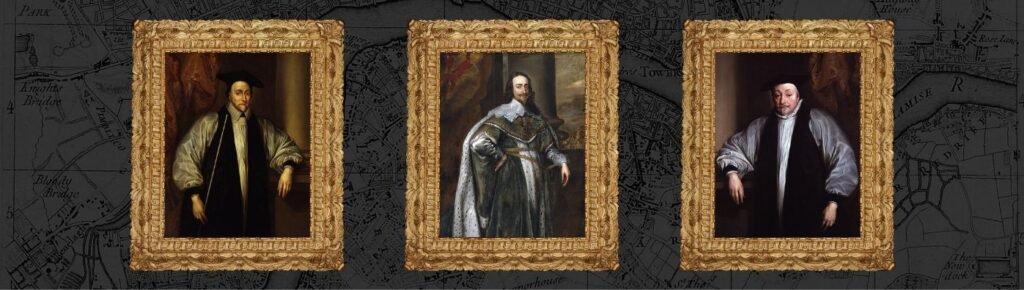
Bishop Juxon, King Charles I, Archbishop Laud
As I’ve summarised in a Why was there an English Civil War?, the events of the 1640s were largely due to a breakdown between the King and Parliament over both religious and financial issues.
These disagreements did not happen overnight, however, and in this more in-depth review I’ll show how they started even before King Charles I took the throne.
Background to the Reign of Charles I
Charles I inherited the throne from his father, James VI of Scotland & I of England. James was a King with a strong belief in the absolutist view of monarchy and a divine right to rule.
James’s upbringing and early succession to the throne of Scotland was probably the single most important factor shaping his belief in divine right.
He became King of Scotland in 1567 when he was only 13 months old, following the forced abdication of his mother, Mary, Queen of Scots. He didn’t accede to the throne of England however, until the death of Queen Elizabeth I in 1603.
Many of his beliefs can be attributed to his Scottish ancestry. As a child, he’d learned that the monarchy in Scotland was politically weak, being constantly challenged by powerful nobles, Presbyterian clergy and factional politics. This instilled in him a deep fear of rebellion, noble power, and clerical interference.
In Scotland, therefore, divine right offered him a powerful ideological weapon to suppress noble rebellion and subordinate the Church to royal authority.
In England, however, the people, and most importantly Parliament, were not used to this type of monarchy. They were accustomed to a strong common law tradition, a powerful Parliament and a long-standing resistance to unchecked royal power
James’s divine right theory and the introduction of a rigid, ideological absolutist monarchy therefore clashed sharply with English political culture. While he personally avoided disaster through compromise and political skill, his ideas deeply influenced his son, Charles I, a legacy that proved catastrophic.
The Reign of Charles I (1625–1649)
Charles I was King of England, Scotland, and Ireland from 27 March 1625 until his execution, towards the end of the Civil War, on 30 January 1649. His reign was dominated by a deep and ultimately fatal conflict with Parliament, that was rooted in financial pressures, religious divisions, and fundamentally opposing views of political authority.
Financial Inheritance and Early Problems
On ascending the throne, Charles inherited substantial royal debts of approximately £900,000 from his father, James VI and I. These debts had accumulated through court extravagance, inflation, and costly foreign policy commitments, particularly wars against Spain and France. As royal income was insufficient to meet these obligations, Charles was immediately dependent upon Parliament to grant taxation, placing him in a position of political vulnerability from the beginning of his reign.
This financial necessity forced Charles to summon Parliament repeatedly, despite his personal conviction that royal authority should not be constrained by parliamentary interference. From the outset, therefore, relations between King and Parliament were strained.
Charles I as an “Absolute Monarch”
Charles I wanted to reign as an absolute monarch, his political outlook being shaped by the theory of divine right. This held that kings were appointed by God, responsible only to Him, and not accountable to earthly institutions. In his view, Parliament existed primarily to advise the monarch and grant taxation, not to challenge royal authority or shape policy.
He also believed that obedience to the king was a religious duty, and that resistance amounted to both political rebellion and spiritual sin. While he did not openly seek to abolish Parliament, he attempted to rule without it whenever possible and deeply resented its claims to limit his authority. His concept of kingship stood in direct opposition to Parliament’s growing insistence that the monarch must govern according to law and custom, particularly in matters of taxation and imprisonment.
Early Parliaments and Breakdown of Trust
Charles summoned his first Parliament in June 1625, seeking funds for war. Unfortunately for him, Parliament granted customs duties for only one year instead of the traditional lifetime grant. Frustrated by criticism and limited financial support, Charles dissolved Parliament in August 1625.
A second Parliament met in February 1626, but it soon attempted to impeach the Duke of Buckingham, a favourite of the King. Charles responded by arresting leading MPs and dissolving Parliament again in June 1626, further damaging political trust.
By 1628, ongoing military failures and severe financial strain forced Charles to summon Parliament once more. This Parliament presented the Petition of Right, a constitutional document asserting that the king could not:
- levy taxes without parliamentary consent,
- imprison subjects without legal cause,
- impose martial law in peacetime, or
- demand forced loans.
Charles reluctantly accepted the Petition in order to obtain funding, but his subsequent disregard for its principles caused yet more problems. In March 1629, following renewed protests over illegal taxation and religious policy, Charles dissolved Parliament yet again.
The Personal Rule (1629–1640)
Following the dissolution of Parliament in 1629, Charles embarked upon a period known as the Personal Rule, governing without Parliament for eleven years. During this time, he sought alternative means of raising revenue, most notoriously through the extension of ship money, a traditional naval levy that he imposed nationwide without parliamentary approval. He also exploited ancient feudal dues, fines, monopolies, and forest laws, generating widespread resentment.
Religious policy further aggravated opposition. Under the influence of Archbishop William Laud (pictured above), Charles promoted ceremonial worship and hierarchical church authority, reforms widely perceived as dangerously sympathetic to Roman Catholicism. This intensified fears that Charles sought to impose both political absolutism and religious uniformity, eroding support among Puritans and political moderates alike.
The Scottish Crisis and Recall of Parliament
The crisis that forced Charles to recall Parliament arose from his attempt to impose an English-style prayer book upon Presbyterian Scotland, provoking rebellion and triggering the Bishops’ Wars (1639–1640). Facing military defeat and financial collapse, Charles summoned Parliament in April 1640. This assembly refused to grant funds until longstanding grievances were addressed. After only three weeks, Charles dissolved it in frustration.
Following the shambles of what is now known as the Short Parliament, military disaster soon compelled Charles to summon Parliament again. In November 1640, a new Parliament assembled, determined to prevent any return to arbitrary rule. This Parliament fundamentally reshaped the English political system, abolishing royal courts such as the Star Chamber, executing the king’s chief adviser Thomas Wentworth (the Earl of Strafford), imprisoning Archbishop Laud, and passing the Triennial Act, which required Parliament to meet at least once every three years. This became known as the Long Parliament.
Final Breakdown and Civil War
The final rupture between the King and Parliament occurred in January 1642, when Charles attempted to arrest five leading Members of Parliament, an act widely interpreted as tyrannical. Trust collapsed entirely. Later that year, Charles raised his standard at Nottingham, initiating the English Civil War. After years of bloody conflict, he was defeated, captured, tried for treason, and executed in January 1649.
The Role of the Bishops
During the reign of Charles I, the episcopacy of the Church of England (a system of church government led by bishops) played a central role in both religious and political life. Among the most prominent bishops were William Laud, the Archbishop of Canterbury, William Juxon, Bishop of London (pictured above), and the Archbishops of York (various). The influence of these men largely shaped Charles’s vision of royal authority and ecclesiastical conformity.
William Laud was appointed Archbishop of Canterbury in 1633 and became the most influential churchman of Charles’s reign. A staunch advocate of High Anglicanism, Laud promoted uniformity of worship, the beautification of churches, and the enforcement of episcopal authority. He saw the Church as a vehicle for moral and social order, aligning closely with the king’s belief in the divine right of kings.
Laud’s policies, however, provoked resistance from Puritans and other reform-minded groups, who viewed them as a drift toward Catholicism.
William Juxon, Bishop of London from 1633 and later Archbishop of Canterbury after the restoration, was a loyal supporter of Charles I. His careful stewardship of finances as Lord High Treasurer and presence at key state occasions demonstrated the close intertwining of episcopal office and royal service. Juxon, like Laud, upheld the king’s authority in both church and state but was considered more moderate in temperament.
The Archbishops of York during Charles’s reign included George Montaigne (appointed 1628) and Richard Neile (appointed 1632), both of whom were allies of the king in promoting episcopal authority and suppressing dissent.
From 1641, however, John Williams was elevated to be Archbishop of York. He presented a contrast to Laud’s rigid policies and while he upheld the episcopal structure, he was cautious in enforcing Laud’s ceremonial reforms and sought to mediate between the king and a fractious Parliament.
His pragmatism reflected both a concern for the stability of the Church and a recognition of the political realities of the early 1640s, when opposition to episcopacy was mounting. Unlike Laud, Williams was willing to temper strict enforcement of ritual conformity to avoid exacerbating conflict. This made him a more flexible but sometimes politically isolated figure.
In addition to the two Archbishops, and Bishop Juxon, there were twenty-three other diocese bishops throughout England (the position had been abolished in Scotland by 1640). These positions were more than ecclesiastical figures, however. They were key pillars of monarchical authority, deeply involved in governance and the maintenance of royal prerogative.
This caused Parliament problems as the bishops exercised significant influence in the House of Lords, Parliament’s second chamber, where they formed a voting bloc known as the “Lords Spiritual.”
Their presence allowed the king to advance legislation and policies in support of his religious and fiscal agenda in opposition to Parliament. Bishops often acted as mediators between the crown and Parliament, defended royal policies, and provided theological justification for the king’s prerogative. Their alignment with the monarchy, however, made them prime targets for Parliamentary hostility.
Parliament’s desire to abolish the episcopacy stemmed from several sources.
- First, bishops were seen as instruments of royal absolutism, obstructing parliamentary authority.
- Second, their enforcement of Laud’s religious reforms alienated Puritans and Presbyterians, who viewed episcopal hierarchy as corrupt and dangerously close to Catholic practice.
- Third, during the 1640s, bishops’ votes in the Lords were crucial in sustaining Charles’s unpopular policies, including forced loans and taxation without parliamentary consent.
Abolishing the episcopacy was therefore both a symbolic and practical means of dismantling royal control over church and state, paving the way for a Presbyterian or more congregational model of governance favoured by Parliament.