

Women's Clothing in 1600s England

Queen Henrietta Maria
Women’s clothing in 1600s England wasn’t just about fashion. It also gave a clear message on several attributes that were important at the time:
- Social class: This would influence fabric quality, cut, and accessories.
- Religious affiliations: Religion dominated many aspects of life in the 1600s, from the flamboyant fashions of court to the plain and unadorned outfits of the Puritans
- Political alignment: Women generally played no part, and took little interest, in politics and it was often the political choices of their husbands or fathers that dictated what they wore. Sometimes this coincided with their religious beliefs, although this was not always the case.
For the purposes of the series I’m writing, I’m considering three distinct groups of women:
Wealthy Royalist Women – Those with families / husbands who were loyal to the King and who liked to flaunt their wealth.
Puritans – These women tended to (but were not always) from families who supported Parliament. They believed in simple, unadorned worship and resented the King for the religious changes he was pushing through. The believed in having high moral standards and opposed activities such as dancing, theatre, and doing anything to excess, which included the way they dressed.
Parliamentary supporters – Although these families supported Parliament, their distrust of the monarchy didn’t necessarily mean they were all Puritans. Some were prepared to accept the changes the King was making to the church, even though they disagreed with him on other matters. As a result, their clothing choices were more subtle. They would typically dress in a more elaborate style than Puritan women but would shun the extravagance of those women with royalist tendencies.
The images on this page give examples of the differences in style between the groups.
- Dresses/skirts:
The basic style of most dresses, irrespective of the wearer, typically consisted of a fitted bodice with a looser, flowing skirt.
Wealthy Royalist Women
Those who had money and status to flaunt would wear garments of luxurious fabrics such as silks, satins, velvets. The bodices would have low, wide necklines and sleeves decorated with ribbons, lace or even elaborate embroidery.
The skirts would be full and flowing, often split to reveal a rich petticoat beneath.
They would often be made of bright colours and be edged with lavish lace around the neckline and cuffs. The image above of Queen Henrietta Maria (wife of King Charles I) epitomises the style of those who may attend court.
Puritan women
In sharp contrast, the bodices of the dresses worn by Puritans were plain, drab, and with high necklines. They would be adorned with plain linen kerchiefs or partlets to cover the chest. They would rarely use lace as a decoration as they would see it as an unnecessary indulgence.
Sleeves were long, or sometimes three-quarter lengths. They may have had turned-back cuffs but were otherwise plain.
The dresses would be made of wool, worsted, fustian, or plain silks (for wealthier women) but they would lack any excessive sheen or patterns. They would also avoid the bright colours favoured by royalists. The most common colours would be russet, grey, brown, dark green, dull blue, plum, or tawny woollens. Black was sometimes worn, but true black dye was costly, and many Puritans disapproved of unnecessary extravagance.
Petticoats were worn but rarely displayed and the skirts of their dresses would often be covered by an apron for modesty and practicality.
Non-Puritan, Parliament Supporting Women
Dresses worn by this group of women were typically something of a middle ground between those described above. The fitted bodice would have long or three-quarter sleeves, and would have a scooped neckline, albeit more modest than those of the royalists. Linen or lace-edged collars may have been worn.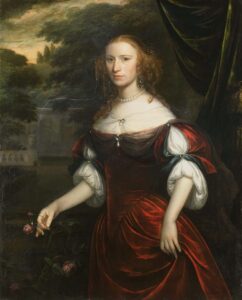
Chosen fabrics would include wool, silk, or a silk blend, depending on their wealth, but they would typically choose the more muted colours of the Puritans, such as russet, grey, plum, dull green, brown, or soft blue. They would be stylish, but not courtly or garish.
Dresses may also be decorated with simple embroidery, ribbon trims, or lace cuffs, but not in the overindulgent manner of their royalist counterparts.
Women would wear a matching or contrasting petticoat that may or may not show beneath the hemline of the main dress.
- Headwear / Hair:
Across all social and religious groups, hair was almost always tied back in a chignon, or similar. Amongst both royalist and parliamentary supporting women, curls or ringlets would typically frame their faces, whereas Puritan women were more likely to have all their hair pulled back from their faces, and covered with a plain linen coif – a close-fitting cap of white linen that covered the ears and was tied with strings under their chin.
In contrast, royalist women, particularly the younger ones, may not have worn any headwear. Instead, they would adorn their hair with ribbons, or jewels to show off their wealth,
Parliamentary supporting women also ‘dressed’ their hair on occasion, but would more often cover it, either with a coif, cap or kerchief decorated with lace or embroidery. These may be set back from the forehead to show some hair or their ringlets.
- Outerwear
For the wealthy woman either of royalist or parliamentary leaning, outdoor wear was likely to consist of a woollen cloak or a mantle, which was a more refined or fashionable version of a cloak. Possibly these were lined and fastened with a brooch, depending on the status of the lady.
If travelling was necessary, especially in rural parts or even within the City, a riding cloak would be worn. In wet conditions it may also be worn with an over skirt (or safeguard skirt) made of sturdy material like worsted wool.
Puritan women would also wear cloaks, but they would be of a plain woollen material, with no accessories.
- Accessories (include handbags)
It probably goes without saying, that accessories were not worn by Puritan women who disliked extravagance or waste of any sort.
Royalist women, however, went to the other extreme. They would wear necklaces, broaches, hair decorations etc to display their wealth and status.
Women whose husbands supported parliament were somewhere in the middle. They may wear a decorative chain around their waist, or maybe a brooch, a wedding ring, or a modest cross. Nothing too showy or ostentatious.
Handbags were carried by the wealthy, although not in the way we know them today.
The most common items were sweet or scent bags. These were typically small, embroidered, drawstring bags that were used to carry sweet-smelling herbs, dried flowers, or perfumed objects. They may also have been used to carry coins or tokens.
Puritans would generally not carry sweet bags. Instead, if they needed to carry any items, they may have tie-on pockets that would be fastened around their waists and concealed under their skirts.
- Shoes
Footwear amongst each class of women was similar in terms of style, although wealthy and/or royal supporting women may be more lavish with decoration and choice of colour.
Essentially, shoes were made of leather with a strap across the instep that was tied with ribbon or leather thongs. Small heels were common by the 1640s, while the front of the shoe was variable depending on the age of the shoe. At the beginning of the century, the toe area was broad and rounded but it gradually narrowed as the century progressed.
Wealthy women’s shoes might be richly coloured (red, green, blue) and may have been made with silk or velvet uppers, possibly embroidered. Puritans would favour leather, dyed either black, brown, russet, or dark red.
Boots would be worn in the winter. Plain leather would be the choice of Puritan women, while fur-lined boots may have been favoured by the wealthy.
Finally, irrespective of class and time of the year, women would have worn protective overshoes, or pattens. These were made of wood or metal and would be strapped over the shoe to raise the foot above the ground – which was often muddy or filthy with animal droppings.