Royal Palaces in the 1640s
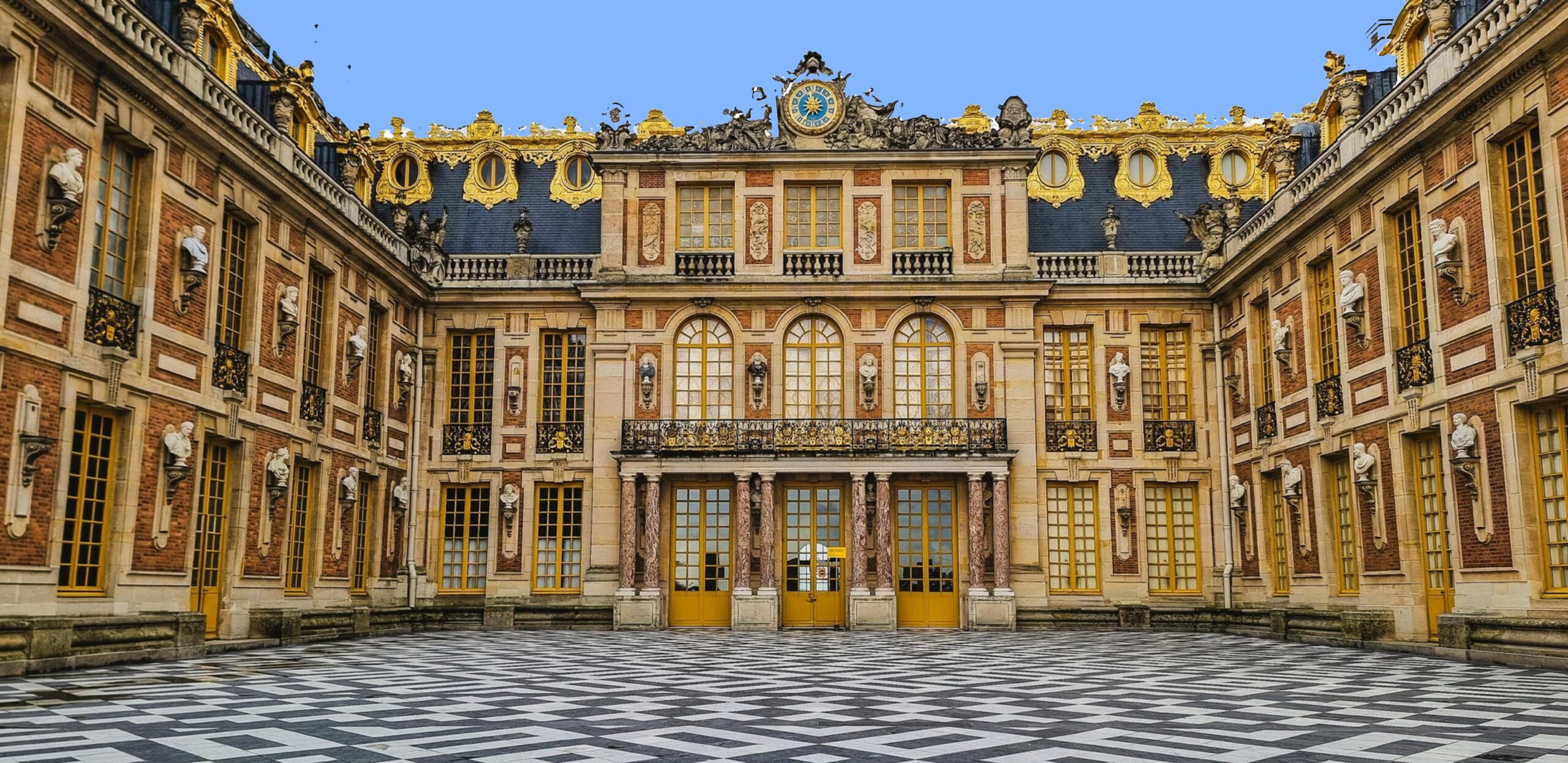
Inner Courtyard at Hampton Court Palace
Royal and Episcopal Palaces in London in the 1640s
1. Palace of Westminster (Old Palace)
The Old Palace of Westminster had its origins as long ago as the 11th century. At the time, it would have been relatively modest in size but was expanded over the medieval centuries.
It was originally built as the principal residence of English monarchs and was also the seat of government (which was headed by the monarch). An adjacent building, Westminster Hall, was a ceremonial and legal centre
From the 11th century until the 1500s, the palace was the residential home of English kings and queens. That changed when Henry VIII moved his main residence to the Palace of Whitehall (see below), although he and subsequent monarchs and their courts continued to use parts of the building until the mid-Tudor period.
By the 1640s, the palace was no longer the main domestic residence but remained the seat of Parliament. Both the House of Commons and the House of Lords met within the Old Palace of Westminster, while Westminster Hall was still central for government and national events.
The UK government continues to this day to sit in the Palace of Westminster, albeit a version that was extensively rebuilt in the 1800s after it was largely destroyed by fire.
Historical Note: King Charles I was tried and sentenced to death at the Palace of Westminster in 1649 in the aftermath of the Civil War.
2. Palace of Whitehall
This was originally developed from York Place, the London palace of the Archbishops of York. In the 1510s–1520s, it was leased and massively expanded by Cardinal Thomas Wolsey who turned it into the finest palace in London. Unfortunately for him, King Henry VIII knew it was far grander than the ageing Palace of Westminster and admired it greatly.
In 1529, when Wolsey failed to secure Henry VIII’s divorce from Catherine of Aragon, Henry put significant political and legal pressure on the Cardinal to relinquish ownership. Wolsey knew that refusing the King was impossible and agreed to ‘gift’ the palace to the King, rather than have it confiscated.
Once under Henry’s control, the Palace of Whitehall became the main royal residence in London. Henry continued to expand it to create a vast complex of state apartments, offices, gardens, entertainment and court life.
Whitehall remained the seat of royal government during the early Civil War until Charles I was executed. After the Restoration (1660), Charles II returned to London but favoured St James’s Palace over Whitehall although the latter continued to house royal apartments.
Over subsequent years, the palace became partially abandoned or underused with some wings becoming derelict. Eventually, it became little more than a ceremonial and administrative hub.
The original palace complex was destroyed by fire in 1698 and today only the Banqueting House (completed in 1622) survives.
The site remained largely derelict until the 1900s (Victorian-era) when the old site was transformed into a formal government district. The whole area of Whitehall remains an important area of government buildings to this day.
Historical Note: Whitehall was the site of Charles I’s execution in 1649
3. St James’s Palace
This was built between 1531–1536 by Henry VIII as a secondary royal residence and administrative court. The palace was/is situated beside St James’s Park and initially housed the monarch’s personal household and ceremonial offices.
St James Palace was used by Tudor and Stuart monarchs when they were not at Whitehall, and it remained a key royal residence and administrative base. Some court business would still operate here during the Civil War period.
St James Palace is still in use today, with much of the external architecture remaining from Tudor times. It is no longer a full-time royal residence but is still used for official functions, receptions, and ceremonial events. It also houses offices for members of the royal family and some court offices.
4. Hampton Court Palace
This was another royal palace that originally (from 1514) housed Cardinal Wolsey. At the time it was a mere manor house but was given over to Henry VIII and from 1529 was greatly expanded.
Standing on the banks of the River Thames, approximately twelve miles from Whitehall, it was originally built as a grand country palace for ceremonial and private royal life, entertaining, hunting, and court life.
Henry VIII and later monarchs used it as a formal residence and retreat due to its location but by the 1640s, when Charles I was forced to flee London, he used Hampton Court as one of his residences. It continued as a venue for royal business around the Civil War era and even after the Restoration (1660), Charles II and his successors used Hampton Court for ceremonial purposes and occasional country retreats.
By the 18th century, the palace had begun to fall out of regular use as a royal home and by 1820 it was no longer a primary royal residence. Over time, the palace became part of the Royal Household’s portfolio of historic palaces and many apartments were opened to the public in the 19th century
Hampton Court Palace still stands today (see image above), but its principal role is as a tourist attraction.
5. Windsor Castle
The oldest functioning castle in the UK, Windsor Castle was founded after the Norman Conquest (11th century) as a major medieval fortress and palace.
It sits approximately twenty-three miles from Whitehall, and was originally built as a defensive fortress, an administrative seat, and a royal residence outside London.
It’s been used intermittently by English monarchs over the centuries; including under Tudor and Stuart rule. During the Civil War, it became a Royalist stronghold, protecting Charles I’s assets as well as taking in Prisoners of War. It was garrisoned by Royalist forces until 1646 when it fell to Parliamentary troops.
Due to its position near the river, Windsor was seen as strategically important to the defence of London. To defend the castle from further attack by Royalist forces, Parliament appointed a governor and sent twelve companies of foot soldiers for the remainder of the war.
The original fortress has been added to over the years, and in the 19th century parts of it were remodelled by George IV and later Queen Victoria for modern royal comfort.
Windsor Castle continues as a Royal residence. It was said to be a favourite of the late Queen Elizabeth II and is still used by the current King, Charles III.
6. Lambeth Palace
This was built as the London residence of the Archbishop of Canterbury (the leader of the Church of England) and has been an Archbishopric site since ~1200.
Prior to the Civil War, Lambeth Palace was home to William Laud (Archbishop from 1633–1645), who was a major religious advisor to Charles I. Largely due to innovations he wanted to introduce across the Church of England and Church of Scotland, the palace was attacked and ransacked by Parliamentarian forces in 1640. Archbishop Laud was subsequently imprisoned in the Tower of London (see below). The palace was partially demolished during the Civil War, with post-war reconstruction later.
Today, Lambeth Palace continues to be the residence of the Archbishop of Canterbury.
7. Fulham Palace
The site of Fulham Palace has been used since Saxon times and has been a bishops’ residence since AD 704.
It was originally built as a residence for the Bishop of London, one of the senior clerics with close ties to both the monarchy and state, and was used to conduct ecclesiastical business, and entertain guests.
During the 1640’s, the palace continued to be used as a Bishop’s residence, by the then Bishop of London, William Juxon, a Royalist supporter and close associate of Charles I.
In 1646, Parliament abolished the episcopacy (the government of the church by bishops) as part of the dismantling of the Church hierarchy, and Bishop Juxon was expelled from the estate.
In 1647, the manor and adjoining buildings were sold to Colonel Edmund Harvey a staunch Parliamentarian. He made the palace his family home and is reported to have entertained Oliver Cromwell there during the Commonwealth period.
Following the Restoration of the monarchy in 1660, bishops were restored to their Sees, including the Bishop of London. As a result, all church and royal lands that had been sold or confiscated were generally returned to their pre‑Civil War owners.
Fulham Palace was therefore restored to the Bishop of London’s ownership.
Fulham Palace ceased to be a residential palace for bishops in the 20th century and is now preserved as a historic and educational site under Church stewardship
8. Tower of London
‘The Tower’, as it is often known, was built in the late 11th century by William the Conqueror. It is situated on the east flank of what became the City of London.
It was originally intended as a fortress, armoury, treasury, and an occasional royal residence, and during the medieval period it underwent a series of expansions.
By the 1640s, it was no longer used as a Royal residence, instead being used to imprison political and military figures. It was a key prison for Royalists and clergy, like Laud. before their executions during the Civil War.
Today, the Tower still stands in London as a museum and home to the Royal Crown jewels.
*
Notable palaces that had not been built in the 1640s
1. Buckingham Palace
Probably one of the most famous of the Royal Palaces, it started life as “Buckingham House”. It was built between 1703–1705 by John Sheffield, Duke of Buckingham
It only gained its Royal connection in 1761 when it was acquired by George III as a private residence for Queen Charlotte. Its expansion into a palace was begun by George IV in the 1820s, and later by Queen Victoria from 1837 onwards.
2. Kensington Palace
This is another Royal Palace that started life as a house. Built between 1605–1619, Nottingham House was a modest brick building. It was only in 1689 that it was acquired and expanded by William III & Mary II
It subsequently became the primary residence for William III and later Hanoverian monarchs.
The information in this post is part of the research undertaken when writing the series The Merchant’s of London. A historical family saga set during the English Civil War and subsequent interregnum (1641-1660).