The City of London - Without the Walls
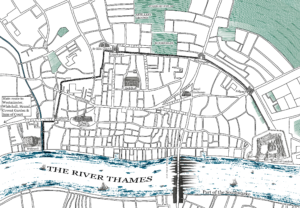
Although the City of London was predominantly the square mile contained within the City walls, there were areas outside the walls that either came under the City’s jurisdiction or were an integral part of life for many Londoners.
Below is a selection of places that are part of the The Merchants of London series
Tower of London
Situated outside the east wall of the City of London on the north bank of the River Thames, the Tower of London was founded by William I, shortly after he conquered England in the 11th century. The initial construction consisted only of the White Tower, but subsequent kings added to its construction, surrounding it with curtain walls, towers, a moat, and defensive works.
Initially, the Tower was intended as a military fortress and was built to dominate the eastern approach to London. It was, however, also a symbol of royal authority and the additional construction also included royal apartments, a great hall, private chambers, and the Chapel of St John.
The Tower’s was used as a royal residence from the late 11th century until the late 13th century. During this period, England’s kings did not have a single permanent capital or palace. Instead, they travelled constantly around the kingdom with their households, staying in a network of royal castles, palaces, and manor houses. The Tower of London was one of the most important of these residences, particularly when the king needed to be in London.
By the 1640s and the reign of King Charles I, the Tower was no longer a principal royal palace and was instead used for a variety of purposes:
- A State Prison
During the 1600s, the Tower was famous as a prison. It was not, however, an ordinary jail. Prisoners were usually important political figures, nobles, bishops, foreign ambassadors, senior military officers, and people accused of treason.
The conditions in which they were held also varied enormously according to rank. Some wealthy prisoners occupied comfortable apartments with servants. Others were confined in small cells.
Unlike prisons such as Newgate Prison or Bridewell Palace (see below), the Tower was intended for prisoners of national importance rather than common criminals.
- England’s Principal Armoury
The Tower stored items such as muskets, pikes, cannon, gunpowder, and other military supplies. This meant that at the time of the Civil War, whoever controlled the Tower possessed one of the country’s largest stockpiles of weapons.
- An Armour Workshop
The Tower employed armourers, gunsmiths, founders, gunpowder experts, craftsmen maintaining the army’s equipment.
- Storage of the Crown Jewels
The royal regalia were normally kept on the Tower under heavy guard. Items included crowns, sceptres, ceremonial swords and other royal treasures.
- Administrative Centre
Several important government offices also operated within the Tower.
Being outside the eastern side of the City walls, the Tower was undamaged by the fire of London and today is one of the most popular tourist attractions in the country. It is still home to the Crown Jewels, which are on public display.
The Tower also continues as the regimental headquarters of the Royal Regiment of Fusiliers and a detachment of the unit that provides the King’s Guard at Buckingham Palace still mounts a guard at the Tower. Along with the Yeomen Warders, they take part in the Ceremony of the Keys each day.
On several occasions throughout the year gun salutes are fired from the Tower by the Honourable Artillery Company, these consist of 62 rounds for royal occasions, and 41 on other occasions.
Finally, at least six ravens are kept at the Tower at all times. This is in accordance with the belief that if they are absent, the kingdom will fall.
Bridewell
This was situated to the west of the City wall directly between Blackfriars and Whitefriars, near the River Fleet and the River Thames. Originally, it was a magnificent palace, built by King Henry VIII in 1515. It initially served as one of Henry’s principal residences, but the king and his court only used the estate for around eight years. In 1553, King Edward VI gifted the estate to the City of London.
At that time, it was repurposed into a complex for housing homeless children and punishing the disorderly. By 1556, it was operating as a jail, and it ultimately became a notorious prison and poorhouse.
By the 1640s, Bridewell was administered by Governors closely linked to the City elite. It was intended to be used as a:
- house of correction
- prison for petty offenders
- place for disciplining vagrants, disorderly persons, and prostitutes
- labour institution where inmates could be set to work
- charitable hospital administration connected with the City’s wider poor-relief network
In reality, however, especially during the years of the war, its role became more flexible. By 1642–43, Bridewell was also operating as a high-security political prison and was used for merchants and other high-ranking officials. This was especially the case if they supported the king, and/or Parliament wanted to make an example of them.
As with most buildings within the City and to the west, most of the original palace buildings were lost to the Great Fire of London. It was rebuilt but the prison element of the building closed in 1855. The name still lives on, however, as Bridewell subsequently became a generic name for a jail, not only in England but in other cities colonised by Britain including Dublin and New York.
Church of St Giles’ without Cripplegate
This is a medieval Anglican church located to the north of the City wall on Fore Street. The word ‘without’ was included in its name to denote that when it was built it stood outside (or ‘without’) the City wall. Despite this it was still very much part of the City of London, as the ward of Cripplegate was one of several that breached the City walls.
Founded around the late 11th century the church is dedicated to St Giles, the patron saint of the handicapped and infirm, and is one of the few medieval churches left in the City of London, having survived the Great Fire of 1666.
Moorfields/Finsbury Fields/Artillery Ground
These were open spaces to the north of the City wall that were used for training the militia (the Trained Bands).
For centuries, the whole area to the north of the City has remained untouched by the expansion of the City largely due to the boggy nature of the area.
- Moorfields:
The area to the north of the wall, adjacent to Moorgate had originally been a literal moor comprising wet, boggy ground. From the 1500s onwards, however, City authorities undertook drainage work which dried the area somewhat and allowed for more practical use.
In the period before the war the area had been cultivated to create an open space where people could walk, meet friends, play bowls, watch entertainers, exercise, or ride horses.
- Finsbury Fields:
Separated by a road that ran across the north edge of Moorfields, Finsbury Fields was a much more expansive open space than Moorfields. To contemporaries of the time, it would have seemed almost like open countryside beginning just beyond the City walls.
For centuries the area had been reserved for military exercise and archery. This continued into the 17th century and meant that it became the prime site for training the City’s militia before and during the war.
- Artillery Ground:
This was an enclosed training ground within the much larger Finsbury Fields. The space was originally used for archery, military musters, tournaments, and weapons practice but over time it evolved to become London’s premier military training ground.
The principal users were the Artillery Company (later the Honourable Artillery Company) who trained officers, veteran soldiers, instructors, skilled musketeers, pikemen and artillery specialists.
This managed military space consisted of a large level field, earth banks in places, targets for shooting, storage buildings, armouries, meeting rooms and officers’ accommodation.
This was not where every member of the London Trained Bands came to exercise. Instead, the Artillery Company acted rather like a military academy.
Strand
Strand was a major thoroughfare connecting the City of London (along with Fleet Street and Temple Bar) to Whitehall and Westminster.
It was a prestigious area to live as some of the wealthiest individuals, including merchants, guild members, and the nobility, gravitated to areas close to trade hubs, government power (Westminster), and centres of finance (the City of London). Strand sat in prime position for each.
In the 1640s, many houses on Strand were grand townhouses or mansions built of brick and stone. They often had impressive facades, and the most distinguished had private gardens and direct access to the river.
These grander houses were interspersed by smaller, often timber framed, houses, that were occupied by merchants and tradesmen.
Although situated to the west of the City, Strand was largely unaffected by the Great Fire. Over time, however, the buildings deteriorated, and all have long been replaced.
Covent Garden
Situated to the north of Strand, this was a development purpose-built in the 1630s for the aristocracy and wealthy gentry. By the 1640s it had developed into a fashionable residential area.
Initially designed by Inigo Jones for the 4th Earl of Bedford, it represented a deliberate attempt to create a continental-style piazza surrounded by elegant houses, all within a short walk from the royal court at Whitehall Palace.
The square itself had an Italianate feel, centred on St Paul’s Church, Covent Garden. The north and east the square was surrounded by large, classical-style houses with uniform façades of brick with stone dressings, sash windows, and arcades. Houses also had private gardens and stables behind.
The atmosphere was genteel, with sedan chairs, liveried servants, and carriages. This was in stark contrast to the cramped medieval streets of the City.
Inns of Court
There were four institutions that made up the Inns of Court:
- Inner Temple
- Middle Temple
- Lincoln’s Inn
- Gray’s Inn
Effectively, they were self-governing societies that trained barristers, housed judges and lawyers, and formed an important part of London’s political and intellectual life. Together they held the exclusive right to call men to the Bar, allowing them to practise as barristers before the King’s courts.
Founded in the 14th century, each court typically contained magnificent dining halls, a chapel, residential chambers, libraries, gardens, and offices thereby offering a lively community to students, practising barristers, judges, servants, and clerks.
By the 1600s the Inns were among the most influential institutions in England, producing many of the lawyers, Members of Parliament, and government officials who shaped the constitutional disputes leading to the Civil War.
By the outbreak of the war, the Inns had become deeply involved in national politics and became places where issues of the day were debated by men educated at the Inns.
Although members held differing political views, there was a noticeable parliamentary sympathy within the legal profession. Many prominent parliamentarians, such as John Pym and Oliver St John, had close associations with the Inns, while distinguished Royalist lawyers such as Edward Hyde also emerged from the same legal culture.
The Civil War inevitably disrupted life at the Inns. Student numbers declined, festivities were curtailed, and many members left to serve either Parliament or the King. Even so, legal education did not cease altogether, and the Inns remained functioning communities throughout the conflict.
Westminster/Whitehall/Bishop’s Palaces
The Palaces of Whitehall, Westminster, and the bishop’s palaces at Lambeth and Fulham were also outside the City walls.
Further details of these and other royal residences can be found here: Royal and Episcopal Palaces in London in the 1640s
The information in this post is part of the research undertaken when writing the series The Merchant’s of London. A historical family saga set during the English Civil War and subsequent interregnum (1641-1660).